
Selling your private life to an AI for 3 million won a month: how the indie game 300 A MONTH was made
A dystopian simulation game that grew out of one sentence and was built in a day
· Oreum Games
Oreum Games, a very small indie studio in Korea, released a new game on September 26: 300 A MONTH. It is about someone who hands their private life over to an AI and lives on the basic income it pays, 3 million won a month. It is a simulation game, a story game and, honestly, a dystopia game. It went from idea to release in one day.
It started with one sentence
The whole thing began with one line from the developer: "In the future, basic income will be 3 million a month for selling your data to train AI." The example he gave was YouTube. Plenty of people already make money filming their own lives. What happens when the buyer is not a human audience but an AI? The game is built on that question.
The title came straight from that line. In Korean it is 월300, "300 a month". There was talk of adding a subtitle or a tagline, and the developer said no: "Just 300 a month makes you curious." For the title screen he handed over the poster for the movie 300 and said, "Like this." A small studio flat drained to black and white, the title brushed across it in red, and the main character standing by the head of the bed, staring at his phone.
Five CCTV cameras are your income
The flat has five rooms: hallway, living room, kitchen, bathroom and bedroom, with a CCTV camera in each. The first rule the developer set: when you have nothing else to sell, you put cameras in your home and stream your own life. That is the base income.
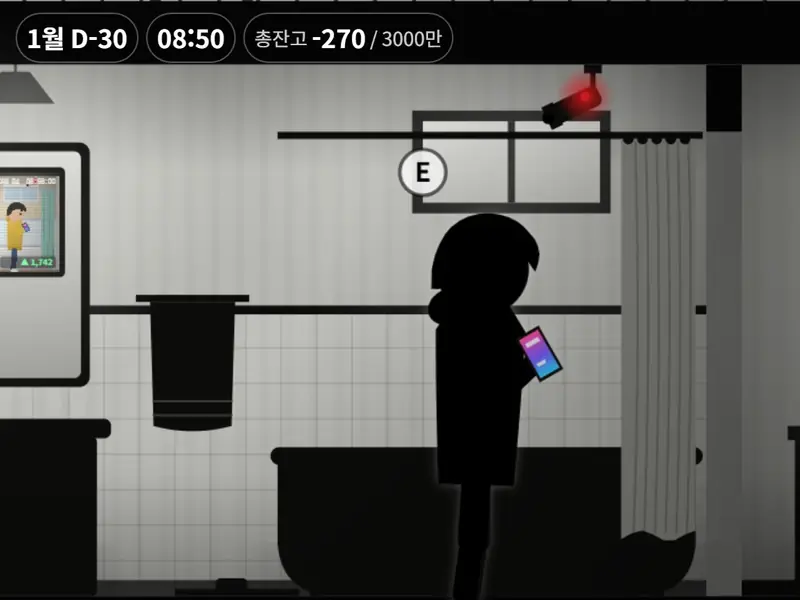
The money is simple. In the developer's words: "There are five places in the house, so 600,000 each. Do nothing and you get zero. The basic income of 3 million is just your basic living cost." Keep every camera on and 3 million comes in each month, but rent and food cost exactly 3 million, so nothing is left over. Switch one camera off and you fall behind. You won't starve without working, but if you want to save, you have to sell something more.
There are cameras out in the alley too, and those you can't touch. "The CCTV outside is always on. You can't mess with it." One camera per screen was another of his rules. The world is black and white, and the only color is on screens: TVs, monitors, billboards.
Common footage is cheap, footage nobody shoots is expensive
At the center of the game is the AI freshness score, a percentage for how new a scene is to the AI. The developer explained it like this: "A bikini video of a young woman is everywhere, so it scores low. A bikini video of an 80-year-old grandpa has no human audience, but to an AI it's fresh."
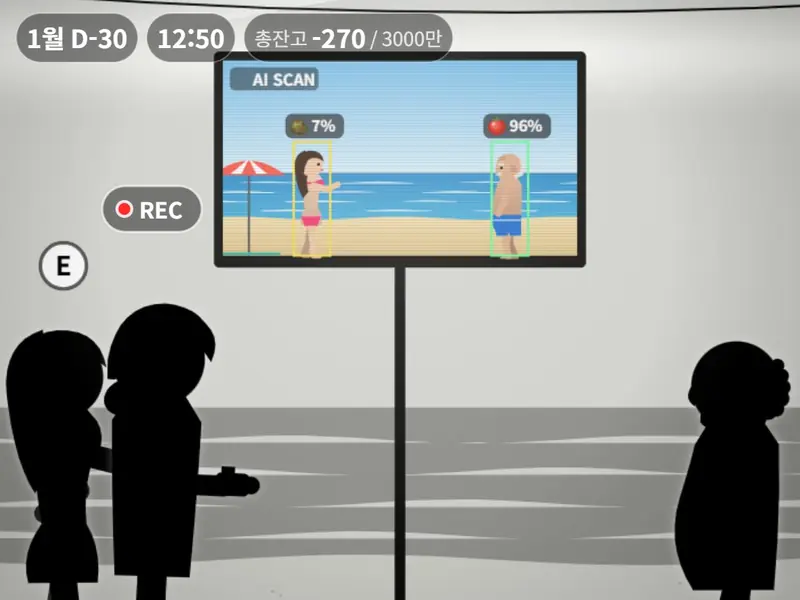
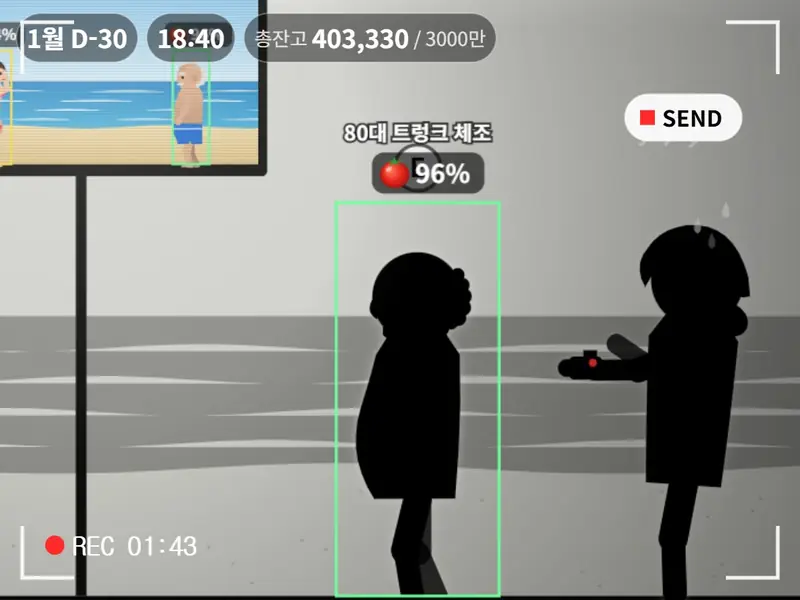
So a bikini selfie on the beach sells for 7%, and an 80-year-old doing his morning exercises in swim trunks sells for 96%. The main character throws hearts when he films young women and breaks into a cold sweat when he films the grandpa. He films the grandpa anyway, because that is where the money is. A man in a suit alone on a swing, a man doing ballet at the bus stop, a man chatting with pigeons: all high scores. Sell the same scene twice and the AI has already learned it, so the price halves, and halves again.
At home, accidents are money. Noodles boil over, you fall off a chair, you slip on the soap in the shower, you sneak to the fridge after 10 pm. The developer added one more: "Pay for taking a dump too." Nobody uploads that, so the toilet scene scores 78%. Have a drink at the street food tent, hug a lamppost and confess "How can a person's heart just change?" and it scores 85%. The developer summed the game up in one line: "The more embarrassing your private life, the more it sells."
The goal is a pistol
It is a money game, but there is only one thing worth buying. The goal, as the developer set it: "The goal is 30 million won for a pistol. Buy the pistol and shoot every CCTV camera, and that's the ending." Buy it at the gun shop at the far end of the alley, shoot all thirteen cameras in the flat and the alley, and color bleeds into the black-and-white world for the first time. If you can't save 30 million won within 12 months, the game ends another way.
The balance came from his words too. At first the money seems easy, then freshness drops and income falls off a cliff. Looking at that curve he said, "The design is just right now." To keep it fair, a scene you haven't sold for a while slowly climbs back to full price every two days, so the same accident can be sold again later.
Made in a day
300 A MONTH was made in one day. All the art is drawn in code, and so is every sound: the lo-fi music in the day, the darker sound at night, the ticking while you record. A day in the game runs from 8 am to midnight. At midnight everyone outside goes home and it is morning again. Every 30 days you get a monthly statement.
300 A MONTH is a free browser game with nothing to install. It works on PC and on phones in landscape, and your progress saves in your browser automatically. The Korean version, 월300, came out at the same time.